


Pharmacology
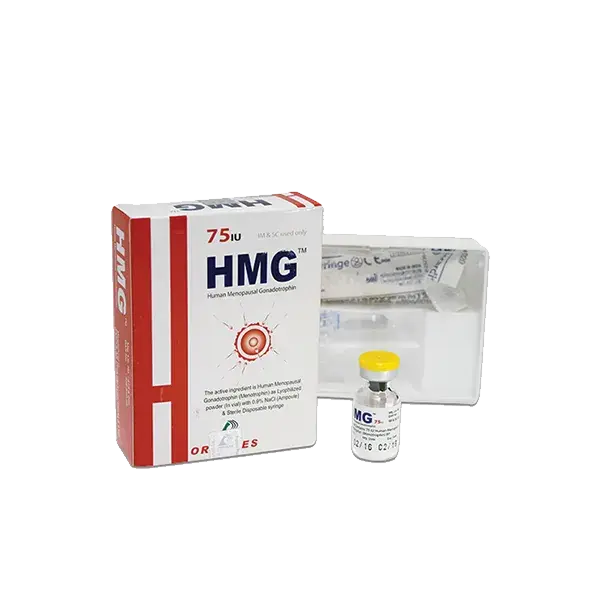
Pharmacodynamic properties: HMG 75 IU/vial directly affects the ovaries and the testes. HMG 75 IU/vial has gametotropic and steroidogenic effect. In the ovaries, the FSH-component in HMG 75 IU/vial induces an increase in the number of growing follicles and stimulates their development. FSH increase the production of estradiol in the granulose cells by aromatizing androgens that originate in the Theca cells under the influence of the LH-component. In the testes, FSH induces the transformation of premature to mature Sertoli cells. It mainly causes the maturation of the seminal canals and development of the spermatozoa. However, a high concentration of androgens within the testes is necessary and can be attained by a prior treatment using HCG.Pharmacokinetic properties: HMG 75 IU/vial is not effective when taken orally and is injected i.m. or s.c. HMG 75 IU/vial’s biological effectiveness is mainly due to its FSH and LH content. The pharmacokinetics of HMG 75 IU/vial following i.m. or s.c. administration were tested product specifically. The maximum serum level of FSH is reached 6-48 hours hours after i.m. injection and 6-36 hours after s.c. injection respectively. After that, the serum level decreases by a half-life of 56 hours (i.m.) and 51 hours (s.c.) respectively. Administered HMG 75 IU/vial is predominantly discharged renally.
Dosage of HMG 75 IU/vial
Sterility in females: The dosage of HMG 75 IU/vial for the induction of follicle growth in normo-or hypogonadotropic women varies according to the individual. The amount depends on ovarian reaction and should be checked by ultrasound examinations of the ovarian and measuring estradiol levels. If the HMG 75 IU/vial dosage is too high for the treated individual, multiple uni-and bilateral follicle growth can occur. HMG 75 IU/vial is administered intramuscularly or subcutaneously and in general, the therapy is begun with a daily dosage corresponding to 75-150 IU FSH. If the ovaries do not respond, the dosage can slowly be increased until a rise in estradiol secretion and follicle growth is evident. Treatment with the same dosage of HMG 75 IU/vial continues until the pre-ovulatory estradiol serum level is attained. If the level rises too quickly, the dosage should be reduced. To induce ovulation, 5000 or 10000 IU HCG are injected i.m. 1 to 2 days after the last HMG 75 IU/vial administration.Note: After a HMG 75 IU/vial dosage too high for the corresponding individual has been administered the following HCG administration can cause an unintentional hyperstimulation of the ovaries.Sterility in males: Initially, 2 X 5000 IU HCG a week are administered until a normal testosterone serum level is reached. Then, an additional dose of HMG 75 IU/vial (3 X 75-150 IU FSH + 75 – 150 IU LH) per week is administered for a few months.
Administration of HMG 75 IU/vial
Method of Administration: HMG 75 IU/vial is administered by intramuscular or subcutaneous injection.Selection of patients:Women: Before treatment with HMG 75 IU/vial is instituted, a thorough gynecologic and endocrinologic evaluation must be performed. This should include a hysterosalpingogram (to rule out uterine and tubal pathology) and documentation of anovulation by means of basal body temperature, serial vaginal smears, examination of cervical mucus, and determination of serum (or urine) progesterone, urinary pregnanediol and endometrial biopsy. Primary ovarian failure should be excluded by the determination of gonadotropin levels. Careful examination should be made to rule out the presence of an early pregnancy. Patients in late reproductive life have a greater predilection to endometrial carcinoma as well as a higher incidence of anovulatory disorders. Cervical dilation and curettage should always be done for abnormal uterine bleeding or other signs of endometrial abnormalities. Men: Patient selection should be made based on a documented lack of pituitary function. Prior to hormonal therapy, these patients will have low testosterone levels and low or absent gonadotropin levels. Patients with primary hypogonadotropic hypogonadism will have a subnormal development of masculinization, and those with secondary hypogonadotropic hypogonadism will have decreased masculinization.
Be the first to review “HMG 75iu 10 vials”
Related products

Peptides
$100.00
New arrivals
$170.00
Shop All
$50.00
Shop All
$50.00
Shop All
$80.00

Shop All
$30.00

Shop All
$120.00

Shop All
$119.00
Reviews
There are no reviews yet.